

The NetSuite Support Industry Is Broken. Here's Why.
"The problem isn't that NetSuite support providers are failing. The problem is that the industry was never designed to solve the challenges businesses face after go-live."
For more than two decades, the NetSuite ecosystem has grown into one of the world's most mature cloud ERP communities. Thousands of implementation partners, consultants, developers, and support firms help organisations deploy and maintain their ERP environments.
By most measures, the ecosystem is successful.
Yet if you speak with CFOs, CIOs, COOs, and business leaders who have been running NetSuite for five or ten years, a common frustration emerges.
"We're spending more every year, but we don't feel like we're getting more value."
The issue is rarely NetSuite itself.
More often, it is the fragmented support model surrounding it.
The industry has evolved around delivering projects, solving technical issues, and responding to change requests. What it has largely overlooked is the ongoing strategic ownership required to maximise ERP value over time.
That gap has created the need for a client-side independent NetSuite managed service.
The Current NetSuite Support Landscape
Today's NetSuite support market is made up of several distinct service providers. Each plays an important role, but each addresses only part of the long-term challenge.
The problem is not that these providers are ineffective.
The problem is that businesses often expect them to deliver outcomes they were never designed to provide.
Implementation Partners: Experts in Building, Not Owning
Implementation partners are the foundation of the NetSuite ecosystem.
They guide organisations through discovery, system design, configuration, data migration, testing, training, and go-live.
Without them, many successful NetSuite deployments would never happen.
However, implementation projects have a natural finish line.
Once the system is live, attention shifts to new implementations, upgrades, or additional consulting engagements.
That is entirely consistent with their business model.
The challenge for customers is that business transformation does not end at go-live.
Processes continue to evolve. Teams change. New opportunities emerge.
Someone still needs to own the long-term journey.
Support Firms: Excellent at Solving Problems
Managed support providers are invaluable when businesses need dependable assistance with everyday operational issues.
They resolve tickets.
Investigate errors.
Maintain scripts.
Support users.
Deliver technical fixes.
These services keep NetSuite operating efficiently.
But support is fundamentally reactive.
It answers questions like:
Why did this workflow fail?
Can you fix this saved search?
How do we update this report?
It rarely asks broader strategic questions.
Should this process still exist?
Is this customisation still necessary?
How could automation eliminate this work entirely?
Keeping the system running is not the same as making the business more competitive.
Freelancers: Flexible Expertise With Limited Strategic Capacity
Independent consultants and freelancers provide specialist knowledge that many organisations value.
They are often highly experienced.
They offer flexibility.
They can solve niche technical challenges quickly.
However, freelancers are generally engaged for specific assignments rather than long-term governance.
Their visibility is often limited to the task they have been hired to complete.
Few are responsible for overseeing the organisation's complete NetSuite strategy across finance, operations, manufacturing, sales, customer service, integrations, security, licensing, and future planning.
Expertise alone does not replace strategic ownership.
In-house NetSuite Administrators: Essential but Often Isolated
Many organisations employ an internal NetSuite Administrator or Systems Manager.
These individuals are often the backbone of day-to-day operations.
They understand the business.
They support users.
They coordinate improvements.
They become the trusted experts inside the organisation.
Yet they also face significant limitations.
One person cannot realistically be an expert in solution architecture, finance, manufacturing, SuiteScript development, integrations, security, AI, reporting, licensing, and change management simultaneously.
As organisations grow, the complexity eventually exceeds what one internal resource can sustainably manage.
The result is not a lack of capability.
It is a lack of organisational support.
Oracle ACS: Deep Product Expertise
Oracle Advanced Customer Services (ACS) provides organisations with direct access to Oracle expertise.
For many businesses, ACS delivers valuable product knowledge, proactive guidance, and operational assistance.
Its focus is naturally centred on helping customers maximise their Oracle investment.
That is an important role.
However, Oracle's perspective is understandably aligned with its products and services.
An organisation may also need independent advice that considers broader commercial, operational, and strategic priorities, including situations where the best recommendation is to simplify, delay investment, or optimise existing capabilities before expanding further.
Those decisions benefit from an advisor whose primary accountability is to the customer rather than the platform.
Offshore Teams: Cost Efficiency Without Strategic Context
Offshore support teams have become an important part of the global ERP services market.
They provide scalability.
Extended operating hours.
Competitive pricing.
Access to technical resources.
For routine support and well-defined development work, they can deliver significant value.
However, offshore delivery often depends upon clearly documented requirements.
It is designed to execute decisions rather than shape business strategy.
Determining what should be built is a different challenge from building it well.
Execution without governance can still lead to increasing complexity over time.
The Missing Layer in the NetSuite Ecosystem
If implementation partners build the system...
Support firms maintain it...
Freelancers solve specialist problems...
Internal administrators operate it...
Oracle ACS provides product expertise...
And offshore teams extend delivery capacity...
Who is responsible for continuously asking whether NetSuite is creating more business value this year than it did last year?
For many organisations, no single provider owns that responsibility.
Instead, it is distributed across multiple vendors, internal teams, and competing priorities.
That fragmentation creates blind spots.
No one is accountable for connecting business strategy with ERP strategy over the long term.
Introducing the Client-side Independent NetSuite Managed Service
This is where the client-side independent NetSuite managed service model fills a critical gap.
Rather than replacing implementation partners, support firms, or internal teams, it sits above them as an independent strategic layer.
Its role is to represent the customer's interests throughout the entire lifecycle of the ERP.
It asks questions that traditional support models rarely prioritise.
Are we receiving full value from our licences?
Which customisations should be retired?
Where can AI automate repetitive work?
Are users adopting new functionality?
Are our implementation partners delivering measurable outcomes?
Is our NetSuite roadmap aligned with the company's three-year strategy?
Which investments should be accelerated, and which should be avoided?
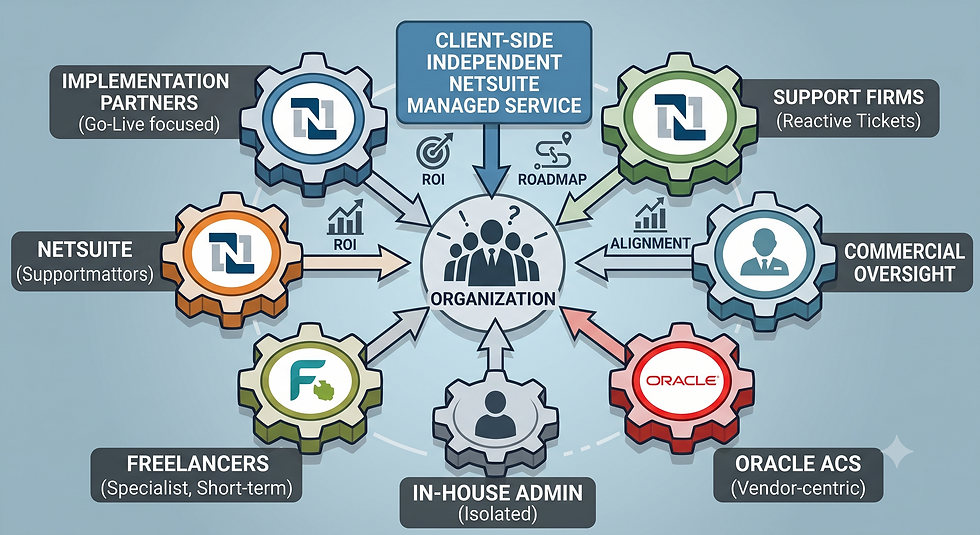
From Vendor Management to Business Stewardship
The client-side independent NetSuite managed service is not another help desk.
It is not another project team.
It is not another implementation partner.
It is an independent steward of the organisation's ERP investment.
Its purpose is to coordinate the ecosystem rather than compete with it.
That means working alongside implementation partners instead of replacing them.
Supporting internal administrators instead of overloading them.
Holding vendors accountable.
Aligning technology decisions with business objectives.
Driving continuous optimisation instead of waiting for the next major project.
The Future of NetSuite Support
The ERP industry is changing.
Artificial intelligence is accelerating innovation.
Business models evolve faster than ever.
Organisations expect continuous improvement rather than periodic transformation projects.
The traditional support model, built around tickets, projects, and reactive maintenance, is no longer sufficient on its own.
Businesses need a layer dedicated to governance, optimisation, commercial oversight, and strategic alignment.
That is why the client-side independent NetSuite managed service is emerging as the next evolution of ERP support.
Not because existing providers are broken.
But because the modern enterprise requires something the industry has never consistently delivered.
An independent advocate whose only objective is ensuring that every NetSuite decision serves the long-term interests of the client.
That is the missing layer.
And for many organisations, it may become the most valuable one.


Comments